I'm tired of doing the polite little dance before saying this.
Yes, Lionel Messi is a genius. Yes, he may be the greatest to ever play this game. Fine. Nobody serious is pretending he is ordinary.
But that cannot be the end of every conversation. It cannot be the magic sentence that shuts everyone up whenever Argentina get another soft landing, another long look from VAR, another emotional rescue act from football's machinery.
I've watched football for decades. It has been my escape, my Saturday religion, the thing I turn to when everything else gets too loud. I admired Messi for years. Properly admired him. But admiration is not blindness, and love for football is not the same as kneeling in front of one player's mythology.
Because the bigger Messi has become, the more football around him has started to feel... bent. Not in some cartoonish, FIFA-fixed-it-all-in-a-back-room way. Not conspiracy-forum stuff. Something quieter. Something harder to prove and honestly harder to shake off once you've noticed it.
Reputation bias. Legacy bias. The subconscious pull to protect the story the whole world wants to keep watching.
So here's the headline, and I mean every word of it: GOAT, yes. But with an asterisk.
And the asterisk isn't on Messi's talent. It's on the game that keeps bending itself around him.
Argentina vs Egypt VAR Controversy: The Short Version
For anyone arriving late, the Argentina vs Egypt controversy is simple. Egypt thought they had scored a second goal through Mostafa Ziko, only for VAR to drag play back to a foul at the start of the move and wipe it out. Later, before Argentina's stoppage-time winner, Egypt appealed for comparable contact in the Argentina box and got nothing.
That is why terms like Messi bias, Argentina VAR controversy, Egypt disallowed goal, FIFA favouritism and referee bias in football exploded around the match. The argument is not that proven corruption has been established. The argument is that the same match appeared to contain two standards: forensic VAR when Egypt hurt Argentina, and a much softer threshold when Argentina survived Egypt.
Argentina vs Egypt Was the Final Straw
Argentina beat Egypt 3-2 in the World Cup round of 16 in Atlanta. On paper it reads like just another chapter in the Messi legend — Argentina go 2-0 down, Messi misses a penalty, somehow survive anyway, then Enzo Fernández wins it in stoppage time.
That's how it'll look in the highlight reel. Slow-motion tears, teammates lifting him off the turf, commentators reaching for poetry they'd clearly written in their heads before kickoff.
But if you actually watched the match — properly watched it, not the edited version — the story underneath is a lot dirtier.
Egypt led through Yasser Ibrahim. Then Mostafa Ziko thought he'd scored one of the great World Cup counterattack goals to make it 2-0. It was electric. Egypt broke from deep, Salah involved, Argentina torn open, Ziko finishing with ice in his veins.
Then VAR reached back. Right back to the start of the move.
The goal was chalked off because Marwan Attia had fouled Lisandro Martínez deep in Egypt's own half, right at the beginning of the counter. The Guardian's live report called it technically correct but still heartbreaking, because the goal itself was magnificent. Fox pundit Rob Green went further, arguing on air that VAR had gone way beyond what it was ever supposed to do — that a toe-touch nearly the length of the pitch away from goal isn't the kind of thing VAR was built to police.
That's the first half of the anger.
The second half arrived in stoppage time. Egypt appealed for a shirt-pull on Hamdi Fathy in the Argentina box. Then Salah was muscled off the ball by Julián Álvarez. No penalty either time. No agonising forensic replay shown to the crowd. Argentina broke, and Enzo Fernández headed home the winner.
GE/Globo's breakdown laid out both late Egypt shouts side by side — the tug on Fathy, then the Salah challenge in the exact move that turned into Argentina's winner. The Guardian's live blog picked up on the same frustration, quoting a reader who asked, quite reasonably, whether that tug was really any less than the offence that had just cancelled Egypt's goal.
That's why this Argentina VAR controversy caught fire the way it did. It was never really about one decision sitting on its own. It was the contrast. One team has a goal dragged all the way back to the first minute of a move. The other team's winning goal survives, no long look, right after Egypt screamed for exactly that kind of scrutiny at the other end.
Fans can live with harsh. What they can't live with is selective. And this felt selective as hell.
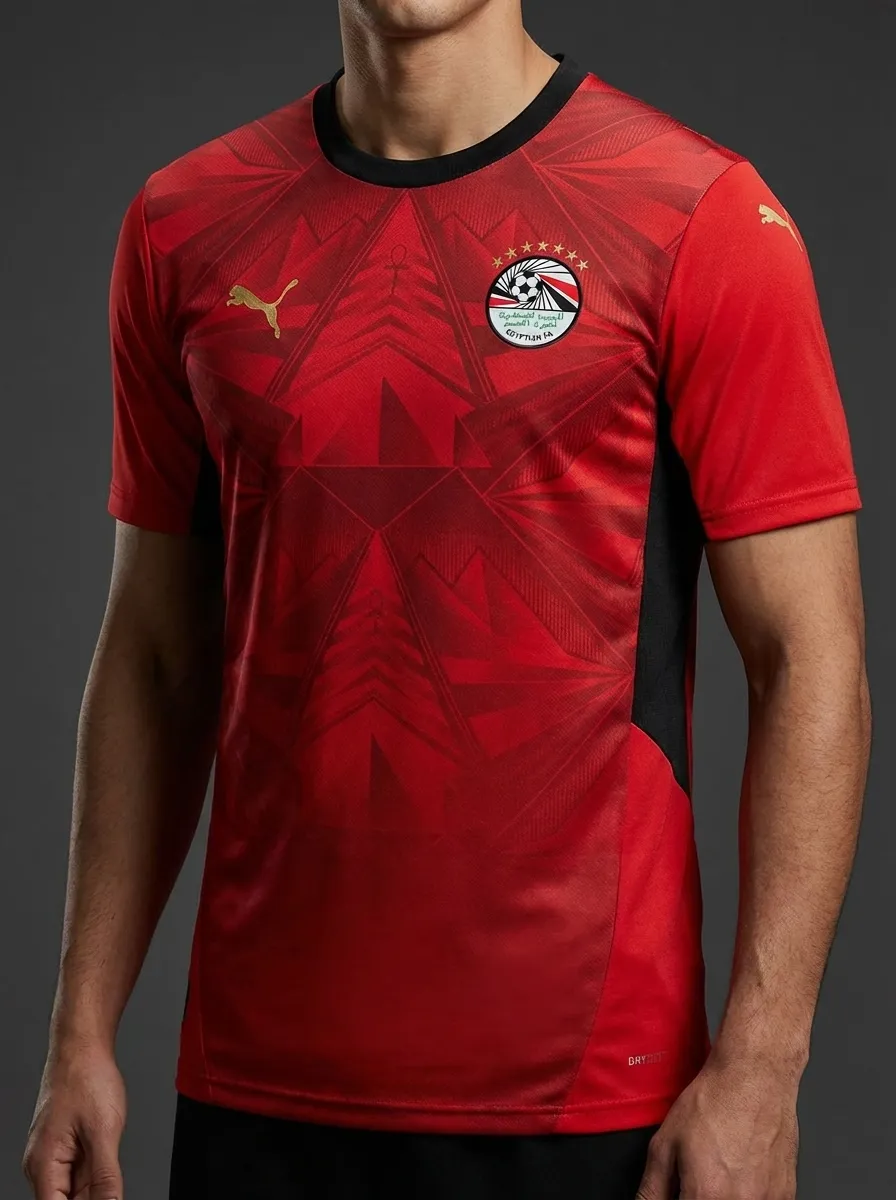
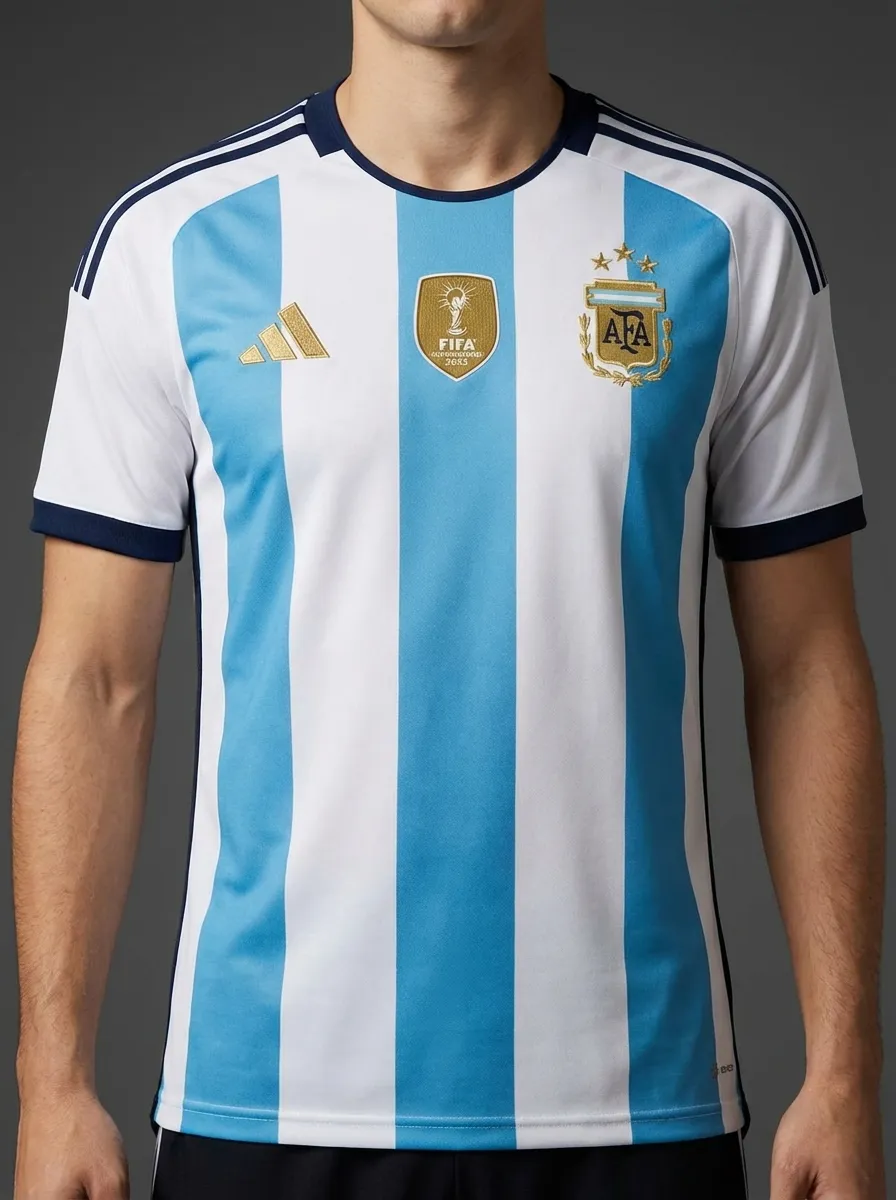
The shirts at the heart of it
Shop Salah, Egypt, Messi and Argentina shirts
This article is about fairness, not merch. The links below are paid Amazon marketplace searches, not verified products or offers. Footy Kits Battle may earn from qualifying purchases.
Search Salah / Egypt shirt listings | Search Messi / Argentina shirt listings
Results can mix teams, seasons, editions and sellers. Check the exact product, seller, price, stock, delivery and returns on the listing you open.
The Disallowed Egypt Goal Was Defensible. That's Not Actually the Point.
Let's get the technical defence out of the way, because people will hide behind it.
VAR was allowed to check that Egypt goal. IFAB's own protocol says goals are automatically reviewed and that attacking-team offences in the build-up are fair game, however far back they happened. Attia did make contact with Martínez. ESPN's own VAR review agreed the intervention was correct, since the foul had a direct effect on Egypt's ability to launch the attack in the first place.
So no — the serious argument here isn't "VAR had no right to look." It did.
The serious argument is this: why did the officials suddenly develop perfect eyesight at the exact moment Egypt were about to wreck the Messi story?
That's the asterisk, right there.
If Egypt's second goal can be wiped out because of a foul at the very start of the move, then the late incidents right before Argentina's winner needed exactly the same oxygen. The same obsessive slow-motion treatment. The same willingness to deflate the drama and disappoint the stadium along with millions watching at home. The same courage.
Instead, Egypt got the letter of the law applied to them in full. Argentina got the flow of the game protected for them.
That gap — that's where trust in this sport starts to rot.
Fans Didn't Need a Conspiracy Theory. They Had Their Own Eyes.
The reaction online was immediate, and it was furious.
Across the X posts circulating in the days after the match, the same complaint kept surfacing in slightly different words: one incident got the full VAR treatment, the other didn't get a second look. One fan pointed out Salah having his foot stepped on in the box with nothing given. Another argued, only half-jokingly, that if Messi had made Ziko's exact run, that goal never gets chalked off. A cleaner version of the complaint just said it plainly — same kind of contact, one goal cancelled, one goal stands, zero consistency.
Then Garry Kasparov, not exactly some anonymous account chasing rage-clicks, put it in the bluntest possible terms. He pointed to Egypt's goal being disallowed for a foul miles from the finish, then Argentina's winner surviving after what many fans saw as the same kind of situation. His conclusion was brutal: FIFA looked like a "corrupt joke" that was "playing favorites for stars". That post had more than 4.36 million views, 194,000 likes and 38,000 retweets when checked. That matters. This is no longer just club-rival noise or football Twitter muttering in a corner. The feeling has escaped the fan tribal wars and gone mainstream.
Alonso Gurmendi, an LSE human-rights fellow rather than a football banter account, made the cleaner legal point. Either mild contact is part of football, in which case Egypt's goal should stand and Salah's appeal is not a penalty, or all contact is a foul, in which case Egypt's goal is out and Salah has to get the penalty. What cannot survive is the third option: contact means one thing when it hurts Egypt and another when it saves Argentina. His post passed 441,000 views when checked because it gave words to the thing fans could feel in their stomach: the law was not being applied like a law. It was being applied like a mood.
Terry Flewers made the same point in pure supporter language: if an accidental step on a foot is enough to erase Egypt's goal, how is Salah not awarded a penalty when fans believed the contact in the Argentina box looked comparable? His post had more than 734,000 views and 42,000 likes when checked. Again, the power of it was not legal complexity. It was the basic football demand for consistency.
Craig Murray put the accusation even more sharply, saying Argentina's winning goal was preceded by several challenges in their own box that looked worse to him than the foul used to kill Egypt's second. Geronimo Morgans asked why two alleged fouls in the Argentina box were not reviewed with the same appetite. Preeti's post focused on a heavy challenge on Salah and the wider card imbalance fans felt they had watched. Those posts do not turn every allegation into settled fact, and I am not treating them that way. But between them they drew well over 1.3 million views. That is not a whisper. That is a crowd looking at the same screen and feeling the same sickness.
Melissa Reddy's reaction cut even closer to the heart of it. She wrote that she loves football, late drama and comebacks, but not the way supporters are expected to ignore VAR and officiating inconsistencies that appear weighted towards certain teams and players. That is exactly the voice this debate needed: not somebody sneering at football's emotion, but somebody saying the emotion is being poisoned by the suspicion that the scales are not level. Her post passed 340,000 views when checked, and it carried weight because it sounded like a football person grieving the state of the game, not a rival fan trying to score points.
Some posts went nuclear — flat-out accusations of cheating, of the whole tournament being rigged. I am not pretending that proves corruption. It does not. But it does prove something is badly wrong when ordinary fans watch the same match and reach for that language immediately.
But fan anger is proof of something else: perception. And in football, perception is basically everything, because this entire sport runs on belief that the contest is real.
Reddit told the same story with a bit more texture and a lot less shouting. The r/soccer thread on Egypt's disallowed goal pulled in thousands of upvotes and thousands of comments. A separate thread on Egypt's late penalty shouts ran into the hundreds of comments on its own. Some users pushed back, arguing Salah's appeal was soft. Fine. But the recurring theme, over and over, was simpler than any conspiracy: if that's the bar for a foul, apply the same bar at both ends of the pitch.
That's not a conspiracy theory. That's the oldest, most basic demand in the sport. Same rules. Same match. Same standard, both ways.
Egypt's Own Players Said the Quiet Part Out Loud
This wasn't just noise from anonymous accounts either.
Egypt's manager Hossam Hassan didn't hold back after the game. The Guardian reported him accusing FIFA of wanting Messi to stay in the tournament, and calling what happened to his team an injustice. Mostafa Ziko went even further, telling GE/Globo the referee had been unfair, that Egypt had been hunted from the first whistle, and that the match had felt directed against them.
Salah, typically, chose his words far more carefully — the kind of restraint you only get from a player who knows every stronger sentence becomes a disciplinary hearing. GE reported him saying he wouldn't attack the referee directly, but that everyone had seen what happened anyway.
Even that restraint says a lot.
Watching Salah walk off after what might be his last World Cup with Egypt, in a match that ended like that — as a Liverpool fan, that stung. He deserved better than being a supporting character in Argentina's comeback story.
And that's really the whole point. Egypt weren't asking for a fairytale of their own. They were just asking for the same rules applied to both boxes.
The Pundits Saw It Too — Not Just Rival Fans
This wasn't limited to Argentina haters or Messi sceptics with an agenda.
Rob Green's criticism on Fox mattered precisely because it had nothing to do with fandom. His issue was with what VAR is even for — a tool meant to fix a clear and obvious injustice, stretched backwards across the entire pitch to dig up a foul that didn't feel remotely proportionate to the goal it erased. A TSN clip that did the rounds on Reddit posed the question better than I could: would they have made that same call the other way around?
That question is really the whole article.
Not "was there contact?" There was.
Not "can you defend the disallowed goal by the letter of the law?" You can, and people did.
The real question is whether that same law gets applied with the same appetite when Messi is the one breaking clear, when Argentina score the counter, when the entire stadium has just witnessed the moment everyone in the building actually wanted.
Deep down, I think most fans already know what they believe the answer is.
This Didn't Start With Egypt. It Just Detonated There.
Argentina vs Egypt didn't create the Messi bias debate — it just lit the fuse on something that's been building for years.
That is why even a lower-engagement X clip matters in this debate. One video circulating after the Egypt match cut together pundit comments around an Argentina-Algeria incident, with the familiar complaint that there was "not even a VAR check" for Messi while other players get punished more harshly for less. I would not build the whole case on a compilation clip, and neither should anyone serious. But the speed with which fans now reach for the archive is telling. The second Argentina get a decision that smells soft, people are not treating it as one weird night. They are filing it under a pattern.
At the 2022 World Cup, Argentina won the whole thing brilliantly, deservedly, and it was still surrounded by endless arguments about penalties, referee pressure and whether the tournament was quietly bending toward the ending everyone wanted. Some of that noise was bitter nonsense from people who'd rather chew glass than say a nice word about Messi. But not all of it was empty. The Netherlands quarter-final was borderline chaos, with Spanish referee Antonio Mateu Lahoz handing out cards like he was dealing a poker hand — and fans on both sides still argued for weeks about what Messi could get away with compared to everyone else on the pitch. Argentine fans had complaints of their own too, and that's worth saying, because bias in football is rarely a clean, one-way spreadsheet. It's messier than that. It's emotion, pressure, and perception colliding in real time.
And here's the part that's almost funny if it wasn't so telling: back in 2019, Messi himself accused Copa América referees of corruption and bias toward Brazil after Argentina crashed out. He said it out loud, on the record, furious. He knows exactly what it feels like to believe the system is leaning away from you.
Which is precisely why Egypt's reaction shouldn't get waved off as sour grapes.
When supporters across different countries, pundits on different networks, and players standing on the actual pitch all describe the same imbalance in different words — football doesn't get to just shrug and say "technically correct" and move on.
Technically correct isn't good enough. It was never supposed to be the whole standard.
Superstar Protection Is Real. Football Just Hates Admitting It.
Every sport has this problem. Football is just too proud to say the quiet part.
Basketball stars get calls. Boxing champions get scorecards. Tennis' biggest names bend crowds and, sometimes, umpires. Football likes to pretend the name on the back of the shirt never affects a decision — but anyone who's watched this sport for more than ten minutes knows that's not true.
A tackle on an unknown winger doesn't register the same way to an official as a tackle on Messi in a World Cup knockout game. A marginal Argentina goal doesn't carry the same weight in that moment as a marginal Egypt goal. A call that sends Messi home isn't just a football decision anymore — it's a commercial one, a broadcast one, a legacy one, whether a single official in that VAR booth would ever admit it.
That doesn't mean anyone's consciously cheating. Nobody needs to be.
It means officials are human. They know the story being written in real time. They can feel the crowd. They understand, even subconsciously, that every extra Messi match is a global television event. And under that kind of pressure, the subconscious can do exactly what corruption never had to.
It tilts the room, just slightly. Just enough.
The Usual Defence Only Makes This Worse
Here is the defence, because we all know it is coming.
Messi did not personally disallow Egypt's goal. He did not summon VAR himself. He did not tell the referee to wave off Egypt's appeals. Argentina still had to score. They still showed nerve. Fine.
And the disallowed goal was not some fantasy decision either. Attia did foul Martínez. ESPN backed the call. The Guardian called it correct. Anyone pretending there was zero legal basis for it is not arguing in good faith.
But none of that rescues the situation. If anything, it makes the whole thing worse.
Because when a decision is technically defensible but emotionally rotten, that puts an even bigger obligation on officials to apply the exact same standard everywhere else on the pitch. If you're going to be forensic, be forensic in both boxes. If you're going to protect the letter of the law, protect it from minute one to minute ninety-plus-stoppage-time. If a foul at the start of a move is enough to kill Egypt's dream, you don't then get to shrug your shoulders when Argentina's winner arrives straight after two separate shouts in the other box.
The problem was never that Messi is not great. We have done that conversation to death.
The problem is that his greatness has grown so large that football now has to actively prove it is still neutral around him. And on this particular night, in this particular stadium, it failed that test.
The GOAT Debate Doesn't End Here. It Gets Messier.
Messi's supporters will call this jealousy. They always do. They will say people cannot stomach greatness. They will point to the assist, the tears, the comeback, the records that keep stacking up. They will say Egypt conceded three late goals and should have defended better.
Fine. But being great does not mean the sport around you cannot become distorted. If anything, the greater you are, the easier that distortion becomes.
Messi's legacy should not need soft edges. It should not need nervous referees. It should not need VAR looking sharper in one direction than the other. His football should be enough.
That's exactly why this asterisk stings.
Not because he cannot be the GOAT. Call him the GOAT if you want. But then have the courage to admit the game around him now looks too emotionally, commercially and institutionally invested in keeping the fairytale alive.
Football Doesn't Just Need to Be Fair. It Needs to Look Fair.
This is the sentence FIFA never seems to fully get.
Football doesn't survive on protocol documents and rulebooks. It survives on trust. The belief that Egypt really can knock Argentina out if they're good enough on the night. That Salah's shirt means exactly as much as Messi's. That Ziko's counterattack gets judged by the same ruler as Enzo's header. That the smaller football nation isn't just there to decorate the bigger one's story before bowing out on cue.
Argentina vs Egypt cracked that belief for a lot of people. It cracked it for me.
Maybe every single call can be defended in total isolation if you squint hard enough at the laws of the game. That is exactly the problem.
But nobody watches football in isolation. We watch it as a pattern, over years, over tournaments, over one big story after another.
And the pattern around Messi and Argentina is getting genuinely hard to ignore now — the grand narrative writing itself in real time, the softer whistle in the big moments, the sudden forensic obsession the second the underdog looks like spoiling the ending, the very human reluctance to be the one who kills the myth.
That's the asterisk.
GOAT, yes.
But this game needs to breathe again.
No player, however magical, should ever feel bigger than football itself. No team, however marketable, should make its opponents feel like they're not just beating eleven players on the night — but a referee, a VAR booth, a broadcast script, and a governing body quietly rooting for a particular ending.
Messi's genius was never in question.
Neither, anymore, is the doubt that's attached itself to the theatre surrounding him.
If FIFA actually cares about the sport more than it cares about the story, that should terrify them — because an awful lot of ordinary fans watched Argentina vs Egypt and walked away thinking the exact same thing.
The GOAT might still be the GOAT. Fine.
But the game around him has an asterisk now. And pretending otherwise is not protecting Messi. It is protecting the illusion.
Quick Answers: Messi Bias, VAR and Egypt's Disallowed Goal
Was Egypt's disallowed goal technically correct?
It can be defended in law because VAR can review attacking-team offences in the build-up to a goal, and Attia did foul Martínez before Egypt broke forward. That is why some rules analysts called the decision correct. The anger is about consistency, not whether there was absolutely no contact.
What was the main Argentina vs Egypt VAR controversy?
The core controversy was that Egypt's goal was wiped out after a long VAR look at a foul near the start of the move, while Egypt's late penalty appeals before Argentina's winner did not appear to receive the same forensic treatment.
Is this article claiming proven FIFA corruption?
No. The argument is about public perception, superstar protection, reputation bias and subconscious referee bias in football. Fans can believe the game looked tilted without proving a formal conspiracy.
Why does Messi's name matter in this debate?
Because Messi is not just another player. He is a global commercial and emotional event. That does not make him guilty of anything, but it does mean football has to work harder to prove the game is still neutral around him.
Comments are open - but moderated
This one is going to split people. If you think the article goes too hard, not hard enough, or misses a key decision, send your take to footykitsbattle.team@gmail.com. The best reader arguments may be added in a follow-up.
Sources and research notes
- Match context and live timeline: Guardian live report; Guardian on Hassan's reaction; Al Jazeera match explainer; Fox Sports; ESPN VAR review.
- VAR/rules context: IFAB VAR protocol.
- Egypt reaction and incident breakdown: GE/Globo on Ziko's comments; GE/Globo on the disputed late incidents; GE/Globo on Salah's comments.
- Pundit and fan reaction: Awful Announcing on Rob Green's Fox commentary; TSN clip circulated via Reddit; supplied X posts including Garry Kasparov, Alonso Gurmendi, Terry Flewers, Craig Murray, Geronimo Morgans, Preeti and Melissa Reddy posts on X from 7 July 2026; later X compilation clip shared by @arnitae3 on 8 July 2026; Reddit threads on r/soccer, r/worldcup, r/sports and r/FootballAfrica.
- Wider context: OCCRP on Messi's 2019 Copa América corruption comments; Fox Sports/AP on the same.